Webinar Summary | What 10 Production Blasts Taught Us About Cutting Cost per Ton (Copy)
Webinar Replay:
Webinar Slides
Summary:
Most blast patterns are inherited, not engineered. A 3meter burden works well enough, so it gets repeated bench after bench, even as the rock, the free face and the geology change underneath it.
We tested what happens when you stop doing that. Over 15 days at three limestone benches supplying a major cement producer, our engineers ran 10 production blasts side by side: 5 using the mine's standard practice and 5 designed bench by bench from drone data, AI rock-mass mapping and pre-blast simulation.
The Results:
- Lower cost per ton in all five paired comparisons, with savings of up to 16% and an average of about 9%
- Up to 37% less explosive in a single blast, with better fragmentation
- Oversize above 1.5 m cut by more than half in the best-performing pair
- Predicted vibration and muck movement closely matched what the seismographs and post-blast surveys measured
This isn't a product demo. It's a field learning from the engineers who did the work. You'll see the full workflow and what drove each result. You'll also see what didn't go to plan: a stiff clay layer that changed how one bench broke, and a stemming and front-row burden change that cost us throw.
You'll Learn:
- Why nominal burden hides huge variation along a single hole (one hole ranged from 0.11 m to 6.38 m)
- How to turn mapped joint sets into burden and spacing decisions
- Why powder factor alone is a poor measure of blast efficiency
- How to check fragmentation, vibration and muckpile movement before you load a single hole
- Where digital designs fail between the office and the bench, and how to close that gap
Who should attend:
Drill and blast engineers, mine managers, quarry operations leaders, explosives professionals and technical leads at quarry and mining operations.
Polls:
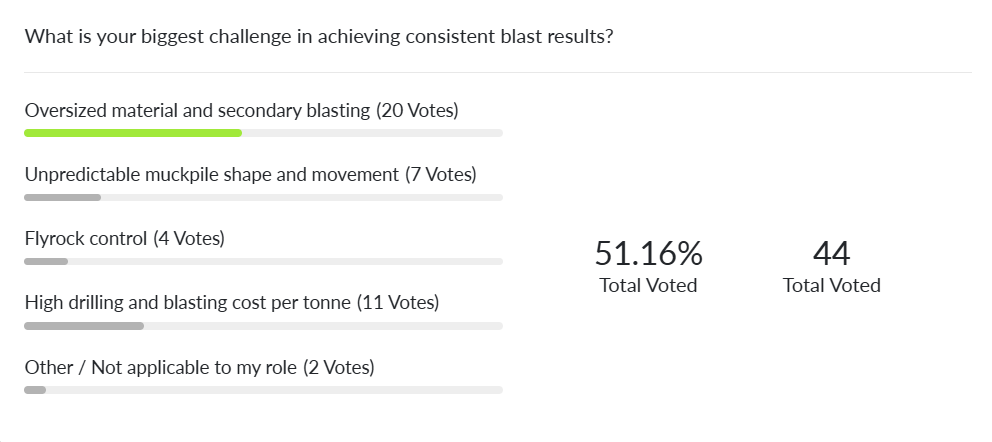
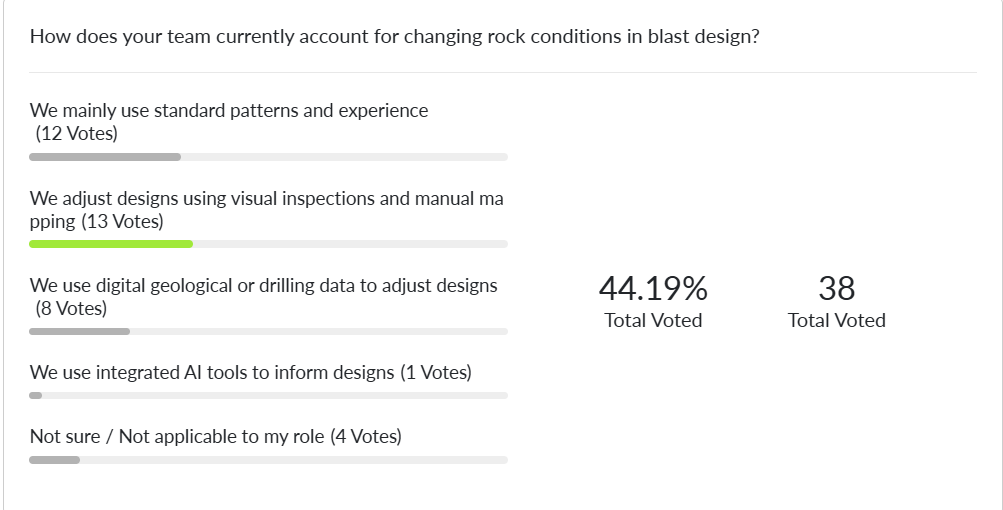
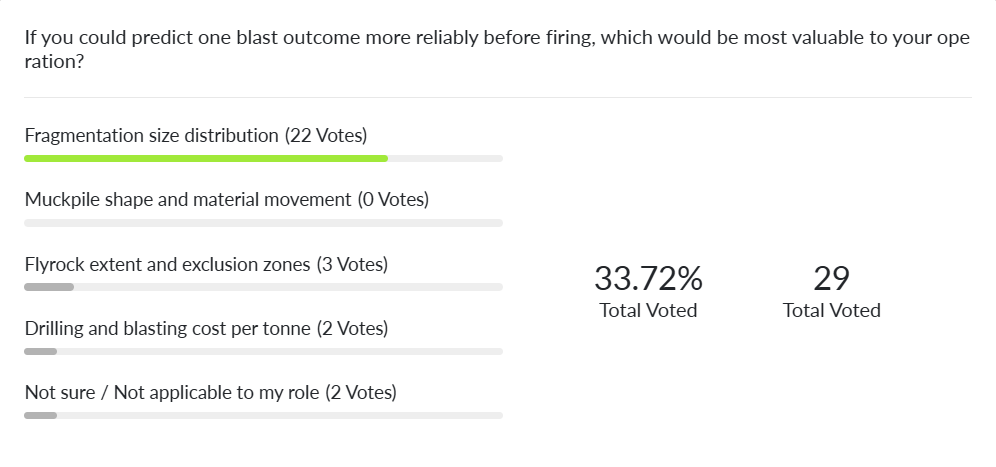
Q&A:
Q. What is the difference between the Fielder app and the platform?
Answer - Strayos Fielder – Mobile application
Primarily designed for field personnel, drillers and supervisors to capture operational drilling information directly at the drill site.
Strayos Platform – Web-based engineering platform
Designed for engineers, blasting professionals and mine managers to perform detailed analysis, design, simulation and optimization.
The Fielder application supports:
- Digital drill logging.
- Recording actual hole depth, drilling time and rock mass observations.
- Capturing and synchronizing field information.
- Offline data collection.
- Communication between field and engineering teams.
The web platform supports:
- 3D blast design and optimization.
- Burden and spacing analysis.
- Fragmentation prediction.
- ORBYM blast simulation.
- Fragmentation AI and vibration analytics.
- Rock Mass AI, slope stability and other site analytics.
Q. How is fragmentation predictive based on given data?
Ans- Strayos uses established empirical fragmentation models, including Kuz-Ram and XP-Frag (Cunningham), combined with AI-based site calibration.
The prediction considers several parameters:
- Blast geometry: Burden, spacing, bench height, hole diameter, hole inclination and sub-drilling.
- Explosive parameters: Explosive type, density, relative weight strength (RWS), charge length and powder factor.
- Timing parameters: Hole-to-hole and row-to-row delays.
- Rock properties: UCS, Young's modulus, P-wave velocity and rock mass characteristics, depending on the selected model.
- Drilling accuracy: Actual drill-hole positions and deviations, where available.
The platform generates a predicted particle size distribution (PSD), including D10, D50, D80 and other size fractions.
The important advantage is that Strayos can calibrate its predictions using actual post-blast fragmentation measurements. As more blast data is collected, the site-specific predictions can improve.
Q. For the Excel spreadsheet, where are you getting all the lithology and other rock mass data for each drill hole, especially if you are not coring each blast hole?
Ans - This is an important technical question.
Strayos does not automatically know the complete subsurface lithology or geological properties of every drill hole simply from its location.
The data can come from several sources:
- Existing geological models: Geological block models, borehole logs, geological sections and mine geological databases.
- Historical exploration data: Core logging, RQD, lithology descriptions, UCS and laboratory test results.
- Field observations: Geologist observations, drill cuttings, chip samples and driller-entered rock classifications.
- MWD (Measurement While Drilling): Penetration rate, torque, feed pressure, rotation pressure and other drilling response parameters, where supported by the drilling equipment.
- Rock Mass AI: UAV-derived 3D bench-face models can identify visible joints and discontinuities, providing structural information about the exposed rock mass.
If coring is not undertaken for every blast hole, we can use existing geological information, field observations and MWD data to estimate or assign representative rock mass properties.
For example, if a geological model identifies a particular zone as weathered granite, the corresponding rock mass properties can be assigned to the relevant holes based on their coordinates and elevations.
Q. How accurate are the AI values in matching real-world values?
There is no single accuracy percentage applicable to every Strayos module or every mine.
Accuracy depends on:
- Quality and resolution of UAV imagery.
- Accuracy of drill-hole coordinates and actual drilling depths.
- Quality of explosive and timing information.
- Geological consistency and variability.
- Availability of historical blast data.
- Quality of post-blast measurements and calibration.
For fragmentation prediction, Strayos compares predicted PSD values against actual post-blast Fragmentation AI measurements. The model can then be calibrated using the site's historical blast data.
For vibration prediction, predicted PPV should be compared against actual readings from calibrated vibration monitors.
For ORBYM, simulated material movement should be validated against actual post-blast surveys and observed muckpile movement.
In our previous Maha Cement limestone mine PoC, we observed approximately 91–93% agreement in the tested fragmentation and PPV predictions. This was a project-specific result, not a guaranteed platform-wide accuracy figure.
- How accurate are the ORBYM results, and do you have any case studies?
ORBYM (Orebody Movement) is a 3D blast simulation technology that combines AI-predicted blast energy with physics-based Discrete Element Method (DEM) simulation.
It simulates how the rock mass moves during blasting and estimates the final location of ore and waste material.
Its key applications include:
- Predicting muckpile movement.
- Understanding ore displacement.
- Estimating ore loss and dilution.
- Supporting selective excavation.
- Improving grade control and dig planning.
The simulation results depend on the quality of the input 3D terrain, blast design, explosive information, timing, material properties and block model.
In our previous Maha Cement limestone mine PoC, we observed ORBYM is matching with real blast movement around 90-95%.
- Were some or all of the presentation examples using electronic or non-electric delay timing?
The PoC was primarily conducted using a NONEL (non-electric) initiation system, and the results were encouraging, demonstrating good blast performance.
However, the PoC was not intended to establish a direct performance comparison between non-electric and electronic initiation systems. Separately, we have conducted several blast simulations and comparative studies using both initiation systems to evaluate their influence on blast performance, including fragmentation, blast movement and vibration.
We would be happy to arrange a technical session to walk you through these simulations, comparative results and our approach to blast performance evaluation in greater detail.
- How is fragmentation measured in Strayos?
Strayos uses deep-learning computer vision algorithms to identify individual rock boundaries from post-blast UAV imagery.
The general workflow is:
- Conduct a UAV survey of the post-blast muckpile.
- Upload the images and generate a high-resolution orthophoto and 3D model.
- Activate the Post-blast Fragmentation and Muckpile AI processing option.
- The AI identifies visible rock boundaries.
- The detected particles are measured and classified according to their size.
- The platform generates particle size distribution curves and fragmentation statistics.
Important outputs include:
- D10, D50 and D80.
- Dmax and other size percentiles.
- Particle size distribution.
- Percentage of oversize material.
- Fragmentation visualization and rock size classification.
The detected particle size is calculated from its dimensions in the image. The measurement settings allow different diameter conventions, such as maximum, minimum or average diameter.
- What is an ideal blasting frequency in your experience, especially for smaller quarries where site managers struggle to find time for pre-blast assessments (e.g., one blast per week)?
The blasting frequency entirely depends on production targets, quarry size, and equipment availability. I understand your concern about the time required for pre-blast assessments, especially in smaller quarries.
I can confidently say that Strayos predictions and AI-driven interpretations are quick and easy to implement in the field. The workflow minimizes manual effort and helps site teams make informed decisions without disrupting routine operations.
We can connect at your convenience to demonstrate how quickly the system works and how flexibly it can adapt to your quarry’s operations. Please let me know a suitable day and time for you.
- Is fragmentation simulated/predicted and then compared with the actual post-blast profile?
Yes. This is one of the most important capabilities of Strayos.
The workflow consists of two stages:
Before blasting – Prediction
The engineer creates a blast design and generates a predicted fragmentation distribution using the available blast and rock mass parameters.
After blasting – Measurement and validation
The post-blast muckpile is surveyed using a drone. Fragmentation AI processes the images and generates the actual measured particle size distribution.
The engineer can then compare:
- Predicted D50 against measured D50.
- Predicted D80 against measured D80.
- Percentage of oversize material.
- Overall particle size distribution curves.
- Performance of different blast designs.
The measured fragmentation data can also be used for site-specific model calibration, improving future predictions.
- How much time does it take to complete the analysis end-to-end, and does it add noticeable delay to the drilling and blasting process?
The pre-blast workflow, from UAV flight and data capture to blast prediction results, typically takes around 30–45 minutes, depending on site conditions and data processing requirements. This workflow is designed to fit into existing operations with minimal disruption to drilling and blasting schedules.
After the blast, another UAV flight is conducted to capture the muckpile for fragmentation analysis. The predicted fragmentation can then be compared with the actual results to evaluate performance
- If Rock Mass AI determines joints, can it also be applied to underground rock data for rock mass classification?
Currently, Rock Mass AI is designed and supported primarily for opencast mining applications, particularly for identifying and characterizing geological discontinuities from exposed rock surfaces.
However, the underlying AI algorithms and approach could potentially be adapted and trained for underground mining applications using suitable underground rock face imagery or 3D scan data.
This could open opportunities for underground applications such as joint identification, discontinuity orientation analysis, structural mapping and supporting rock mass characterization.
We would be happy to discuss the technical feasibility, potential customization and training requirements for underground applications in a dedicated meeting with our technical team.
- Is this technology going to be used in modern mining?
Absolutely. AI, UAV photogrammetry, 3D modelling, machine learning and digital mine planning are increasingly becoming part of modern mining operations.
Strayos brings several of these technologies together in one platform.
Examples include:
- AI-based blast design and optimization.
- Fragmentation prediction and measurement.
- 3D burden and spacing analysis.
- Drill deviation analytics.
- MWD-based drilling analytics.
- Vibration prediction.
- Orebody movement simulation.
- Slope Stability AI.
- Rock Mass AI.
- Haul Road AI.
- Stockpile and volume analytics.
The major shift is from reactive mining operations towards predictive and data-driven mining.
Instead of identifying problems only after blasting, excavation or production, engineers can evaluate potential outcomes before implementing operational changes.
- Can blast simulation be optimized to eliminate the primary crusher in scenarios where there is no PPV (peak particle velocity) limit?
This requires an important engineering distinction.
If there is no PPV restriction, the engineer has greater flexibility to optimize the blast for fragmentation rather than being constrained by vibration limits.
However, eliminating the primary crusher is not necessarily a realistic or technically appropriate objective for every mine.
The objective should be to achieve the required fragmentation at the lowest overall mining and processing cost.
This can be approached by:
- Optimizing burden and spacing.
- Adjusting hole diameter and bench height.
- Optimizing powder factor.
- Evaluating explosive type and energy distribution.
- Optimizing timing and initiation sequence.
- Reducing oversize and secondary breakage.
- Evaluating the crusher's feed-size requirements.
Strayos Fragmentation Prediction can evaluate different blast configurations before implementation.
For example, if the crusher has a maximum feed opening of 1,000 mm, the engineer can evaluate the predicted percentage of material exceeding that size.
However, even if vibration is not a limiting factor, flyrock, airblast, ground stability, equipment safety and regulatory requirements must still be respected.
The objective should be crusher-feed optimization and reduced downstream processing costs, not simply increasing explosive energy.
- What KPIs does this target and improve (e.g., powder factor, fragmentation, excavator productivity), and how?
Strayos can help improve several operational and financial KPIs.
| KPI | How Strayos contributes |
|---|---|
| Powder factor | Evaluates explosive consumption against fragmentation targets |
| Fragmentation (D50/D80) | Predicts and measures particle size distribution |
| Oversize percentage | Identifies potential secondary breaking requirements |
| Drilling accuracy | Identifies deviations and actual hole-position differences |
| Drilling productivity | Uses drilling performance and MWD analytics |
| PPV | Supports vibration prediction and monitoring |
| Airblast | Supports airblast prediction and monitoring |
| Excavator productivity | Better fragmentation can improve digging conditions and reduce oversize handling |
| Crusher throughput | More consistent feed size can support improved crusher performance |
| Secondary breakage cost | Helps reduce oversized material |
| Ore loss and dilution | ORBYM supports post-blast ore movement and dig planning |
| Bench and slope safety | Rock Mass AI and Slope Stability AI support geotechnical assessments |
The most important KPI is not necessarily the lowest powder factor or the finest fragmentation.
It is the lowest overall cost per tonne while maintaining safety, production and downstream processing requirements.
Speaker
Moderator

New technologies are rapidly changing the drilling, blasting, mining, and aggregates industries, empowering them in ways never before possible. Make sure you are taking advantage of the best tools available.
Check out our 2 Free E-books on AI applications for the drilling, blasting, and mining industries to see all the amazing advances that are available.
AI Guide for Drilling and Blasting
AI Guide for Mining
Watch our videos:
YouTube