Webinar Summary | Better Blasts, Safer Slopes: Connecting Rock Mass AI to Engineering Decisions
Webinar Replay:
Webinar Slides
Summary:
Join Strayos Solutions Engineer Jose Manuel as he shares practical applications of Strayos Rock Mass AI, Rock Mass Rating, Lithology AI and Kinematic Analysis for drill-and-blast and geotechnical teams.
The same joints, bedding planes and lithological changes that influence blast fragmentation also shape bench and highwall stability. How can drill-and-blast and geotechnical teams use this information together?
Watch a walkthrough of how AI-assisted rock mass characterization can support geology-informed blast planning and structural assessment. Using a shared bench example, we’ll explore how to map discontinuities, interpret lithological domains, evaluate rock mass quality and screen potential failure mechanisms and translate those findings into coordinated engineering decisions.
What you’ll learn:
- For drill-and-blast teams: Use rock structure and lithological variability to inform blast design, improve fragmentation consistency and manage backbreak.
- For geotechnical teams: Interpret discontinuity sets, assess rock mass quality, Interpret Rose diagrams and screen potential planar, wedge and toppling failure mechanisms.
- For both: Connect pre-blast geological assessment with post-blast fragmentation and wall-condition reviews.
Polls:
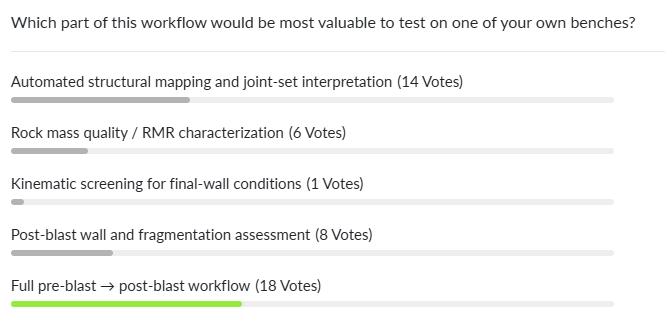
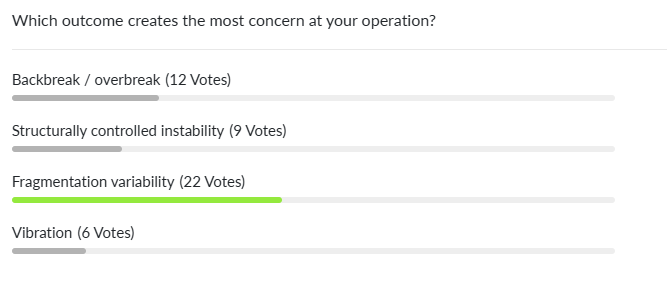
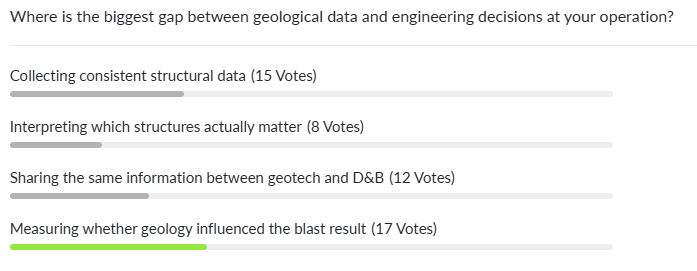
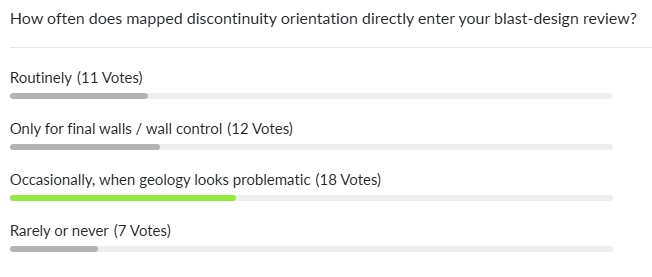
Q&A:
- What is the direct influence of humidity on the results, and how does Strayos consider it?
Assuming that humidity would be moisture content. It would influentiate Both rock-mass behavior and the interpretation of exposed surfaces. In Strayos, groundwater-related conditions are treated as engineering inputs rather than something inferred automatically from imagery alone. Surface moisture can also influence the visual appearance of the rock face, so visually derived domains should be interpreted together with site knowledge and field observations. - What is the advantage of using Strayos instead of other software such as Geovia or Surpac?
The main advantage is workflow continuity. Strayos can connect 3D survey data, rock-mass characterization, structural interpretation, blast design, and post-blast results in the same environment. This allows teams to compare what was mapped, what was designed, and what actually happened, supporting a site-specific feedback loop. Strayos can also complement specialist mine-planning or geotechnical software rather than necessarily replacing it. - We use Maptek laser scanning and PointStudio for structural picking and blast analysis. Can we bring laser-scanning data into Strayos?
Yes, provided the 3D dataset can be supplied in a format supported by Strayos. The workflow is not limited to drone photogrammetry. Laser-scanning or other 3D datasets may also be used when they contain the geometry and surface information required for the analysis. - Can Strayos be used for underground designs?
Potentially, yes. Strayos is primarily used in surface-mining workflows, but some underground datasets can also be analyzed if suitable 3D data of the excavation are available. The applicability depends on the capture method, visibility of the rock surface, and whether the resulting dataset can be processed in the platform. - If we want to review post-blast stability, do we need to upload another point cloud and reanalyze it, or can it be identified beforehand?
Pre-blast mapping can identify structural conditions and kinematically possible mechanisms before the blast. However, once the blast occurs, the geometry changes and new rock may be exposed. If the objective is to assess the actual post-blast condition, the wall should be captured again so the pre- and post-blast conditions can be compared. - Can we start this workflow using only drone scans of the bench and face, without detailed geological information or core data?
Yes. A good 3D capture of the bench and exposed face is enough to begin mapping visible discontinuities, their orientations, and representative joint sets. Core data are not required for the first stage of the workflow, although subsurface data can provide useful additional context where available. - For limestone, how can we reduce boulder formation in the stemming area?
There is no single design change that will eliminate boulders in the stemming region. Oversize near the collar can be influenced by stemming length, collar burden, explosive distribution, drilling accuracy, confinement, and local structural conditions. Rock-mass mapping can help identify whether persistent joints, large blocks, or other structural features coincide with areas where oversize is repeatedly observed. - How are you getting RQD if you are using rotary blast holes rather than core drilling? Are you scanning the holes before loading?
The RQD used in this workflow is not obtained by scanning blast holes. It is estimated from the mapped discontinuity network. Representative joint-set spacing is used to calculate volumetric joint count, Jv, and an empirical relationship between Jv and RQD is then used to estimate RQD. This should be described as estimated RQD derived from structural mapping, not core-measured RQD. - How can we reduce flyrock, airblast overpressure, and vibration by optimizing explosives?
Rock Mass AI does not automatically determine how to eliminate flyrock, airblast, or vibration. It provides additional geological context for the blast-design review. These outcomes depend on factors such as burden, confinement, stemming, explosive distribution, timing, free-face conditions, and geological structure. The final design decisions remain site-specific. - Can Strayos connect with other software or incorporate information provided by the drilling team?
Potentially, yes. Drilling and other operational datasets can add useful context to the geological and blast model, particularly when they contain spatially referenced information such as hole geometry, drilling response, rock-property indicators, or other measured parameters. The exact integration depends on the source system and data format. - Does a staggered blast pattern have less impact on bottom fragmentation?
Not necessarily. A staggered pattern is not inherently better than a square pattern for bottom fragmentation. Fragmentation depends on burden, spacing, subdrill, explosive distribution, initiation sequence, bench geometry, and the rock mass itself. The most appropriate pattern should be evaluated using site-specific geology and measured blast results. - How can we achieve good fragmentation when blasting water-containing holes?
Water-containing holes require both geological and explosive-design considerations. From the rock-mass side, it is important to understand block size, joint spacing, structural variability, and whether the planned burden and spacing are appropriate. From the explosive side, the product must be suitable for wet-hole conditions and loaded according to the manufacturer’s and site’s procedures. - Does a kinematically critical structure mean the slope is unstable? No. A kinematically critical structure means that the geometry satisfies the conditions required for a particular failure mechanism to be possible. It does not mean the slope will fail. Actual stability also depends on factors such as discontinuity persistence, friction and shear strength, water conditions, release surfaces, intact rock bridges, scale, and overall slope geometry.
- We normally use water gel and ANFO for limestone blasting. How can we reduce an inconsistent toe area?
An inconsistent toe can be caused by several different factors, including insufficient subdrill, hole-depth or deviation issues, hard geological bands near the floor, local burden variation, energy distribution, and changes in rock properties. The first step should be to determine whether the toe consistently correlates with a specific geological or drilling condition.
Speaker

Moderator

New technologies are rapidly changing the drilling, blasting, mining, and aggregates industries, empowering them in ways never before possible. Make sure you are taking advantage of the best tools available.
Check out our 2 Free E-books on AI applications for the drilling, blasting, and mining industries to see all the amazing advances that are available.
AI Guide for Drilling and Blasting
AI Guide for Mining
Watch our videos:
YouTube