Webinar Summary: Where Did Your Ore Go? Cut dilution. Protect ore. Plan selective digging with ORBYM
Webinar Replay:
Download Slides:
Summary
CEO Ravi Sahu presented a walkthrough of an AI + physics approach to blast‑movement modeling using your existing geology, drilling, and survey data to predict where ore and waste will land after the blast—fast enough to guide digging and plant feed decisions. We covered how to build a 3D post‑blast block model that reallocates ore and waste at high resolution, how the model learns site‑specific parameters (burden, timing, rock characteristics) and updates with new surveys, how an AI + physics engine captures muckpile flow more accurately than traditional estimates, how to produce near‑real‑time ore–waste boundary maps for mark‑out and selective digging, how to run simple “what‑if” tests on timing and burden to reduce dilution before you fire, and how to plug in standard inputs (geology, drill data, pre/post‑blast surveys) and validate predictions with feedback loops. People such as drill & blast engineers and supervisors, mine geologists and grade control teams, and short‑range planners and processing leads attended.
Polls:
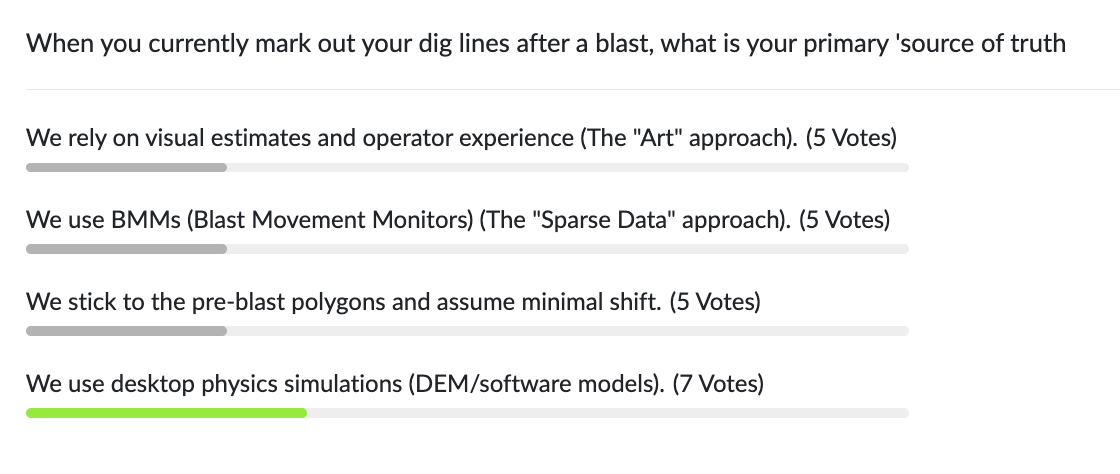
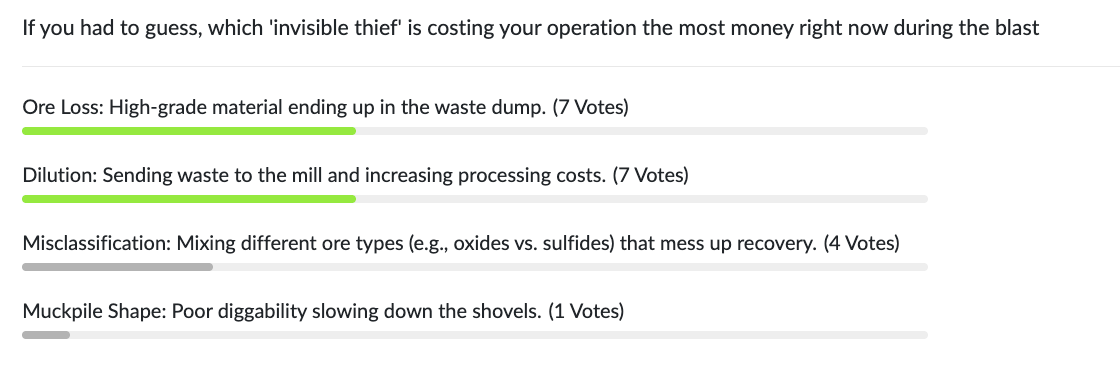
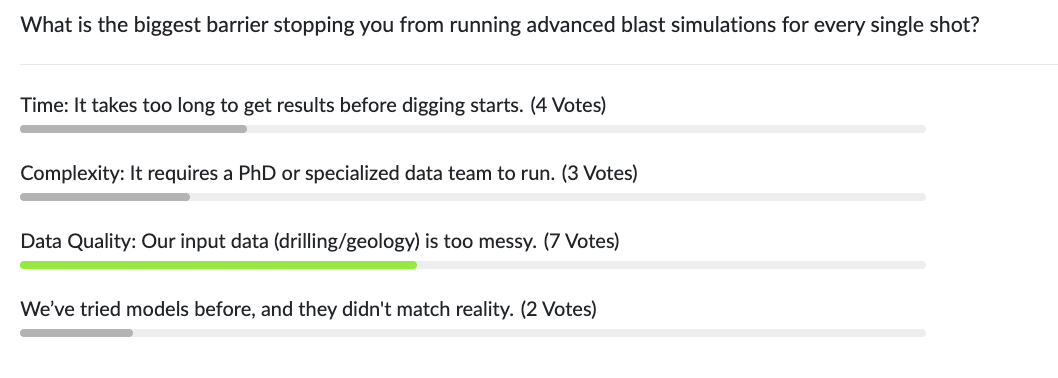
Q&A:
How do you prepare the dataset for your AI model? how the inputs and outputs were generated?
You start with your drone survey type and you have to have a high resolution digital elevation models. Then you have your organized drill design data or your blast parameters. Those are your key inputs. Then you have the geological model data and any type of geotechnical information you can bring in. For example, backbreak data you can bring in. Those are useful there. Then after, from the learning perspective calibration, you can evolve this data set. The other area I would consider is your block models. If you’re block models are continuously being updated, that also helps in the calibration type of model.
Do you use a post-blast drone survey as an input?
Yes, that is one of the key parameters for the AI for the calibration. Utilization of the post blast or drone survey. We take as much data generated from the pre-blast which each movement and then we use that information compared with the post blast what are the significant differences there and then that gets fed back into the AI model.
What software did you use for DEM modeling?
DEM Modeling is mostly the. We don’t use the actual software itself. Within the physics modeling, there are tools: particle n-sis models. That’s on the DEM modeling side.
Is the pre and post blast rock mass balanced?
It doesn’t happen often which mean you may have a pre-blast rock mass survey that has been done or if you have already existing data. After the blast occurs, the data changes. That’s based on the calibration. That depends on the geologist and the control site if they have that data and if they have the new rock mass. that information sometimes is a limiting factor that nobody is collecting that after the blast.
Since data quality matters, have you quantitatively checked how well both the synthetic data your model uses and the synthetic data it produces match real blast data? How do you ensure the quality and realism of these synthetic datasets?
With the approaches as new data is coming and the calibration will become more important. What I anticipate at this moment, the centric data that has been generated it is lively predicting what the burden velocity movement as well as the energy distribution. We are seeing are lively metrics there. After we combine the physics model, the goal is to make the material movement more accurate and that will require more motor trations there.
The quality we make sure that we have a pre cleanup process. any data coming in from the survey side or the drill and blast loading and timing, any additional parameters including the rock blast. We evaluate with the QAQC approach. Then the new synthetic data we are creating. Then for example looking at the rock movement, the XYZ vectors so those also get validated by the scripting technology the accuracy of the data.
Which AI are you using? Is it an off-the-shelf solution or a RAG system based on an open-source model?
This is trained in-house. We don’t use a RAG. It’s a combination of a physics model and a chronolution newal network. You can search and there is a frame work there. There’s no full developed model you can utilize off the shelf but there is framework called physics informed newal network. There have been alot of papers written but that’s kind of the framework we’re using but we still have developed the architecture by taking the chronolution newal network, we trained it, and incorporated with physics. We don’t use RAG for this as this is an in-house developed system.
Presenter:

Ravi Sahu, CEO and Founder of Strayos
With a background in engineering and over a decade of experience in digital transformation and product management, Ravi worked with Fortune 500 companies worldwide before founding Strayos. He holds an MBA from Washington University in St. Louis and is knowledgeable and expert in leveraging AI.
Ravi has taken Strayos to the next level by developing advanced computer vision and machine learning solutions to optimize operations, improve safety, and enhance efficiency in the mining industry.
New technologies are rapidly changing the drilling, blasting, mining, and aggregates industries, empowering them in ways never before possible. Make sure you are taking advantage of the best tools available.
Check out our 2 Free E-books on AI applications for the drilling, blasting, and mining industries to see all the amazing advances that are available.
AI Guide for Drilling and Blasting
AI Guide for Mining
Watch our videos:
YouTube
Follow Us on Social Media:
LinkedIn
Facebook
Instagram